Financial bubbles are not unfamiliar to economists; in fact, many believe we are experiencing one right now as mass investment and global hype inflates the prices of AI related stocks. Over the past few centuries, many such bubbles have become inflated and burst, each owing to the sharp rise in price of one of a diverse range of assets, be it real estate or new technology. Few know, however, the surprising culprit behind the world’s first speculative bubble.
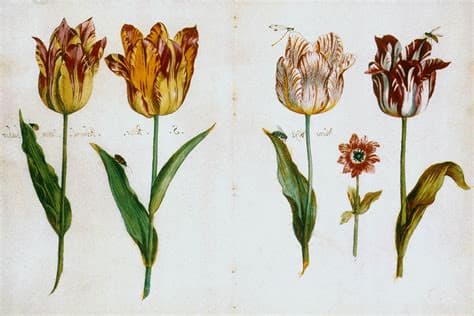
The year is 1637, and a Dutch catalogue boasts pages of ornate and delicate tulips anywhere from 200 to 5,500 florins. Not three years earlier, specialist artisans could expect to make in the region of 300 florin in an entire year. Records at the Trinity College Dublin library show that at the bubble’s peak, the most uncommon of tulips were fetching ten to 20 times a skilled craftsman's annual wage. It is not surprising that ‘tulip mania’ gripped the entire population; from the peasantry to the elite, everyone had something to gain.
Tulips made their way to Europe for the first time in the 16th century through spice trading routes from central Asia. They arrived in the markets, then, with an implicit air of exoticism. They looked like nothing on the continent. Over the following years, tulips rapidly populated the gardens of the gentry; it became a faux pas, even, for men of fortune to be found lacking a collection. The bourgeoisie soon followed suit, seeking to imitate the allotments of their wealthier neighbours. Demand grew rapidly, and cultivators began to perfect techniques to produce the finicky flowers at home. To boost the craze further, beautiful multi-coloured variants began to emerge, which had evolved by chance after a mosaic virus strain affected some of the plants.
In 1634, the country was so gripped by the trade that regular industry was neglected and people were known to stake their fortunes for the purchase of a small number of bulbs. Soon after, regular sale of rare varieties was established on the stock exchange in Amsterdam and a whole host of Dutch towns. In the Library of Economics and Liberty, it's noted that many individuals grew suddenly rich, profiting from rapid fluctuations in market price. Everyone was soon vying for their share of the speculated gains. Wealth poured in from across the nation, and prices soared as buyers signed contracts to purchase bulbs which were not yet even planted. New laws were devised to cope with this intricate market phenomenon, one which the world had not before seen.
This market structure could not last. As the sensible started to sell off their prized collections, the public was seized in the fear of losing out. Tulip prices plummeted – buyers refused to uphold their contracts, and courts faced a final issue. A law passed that allowed purchasers to be relieved of their contracts for a fraction of the original price, leaving anyone still holding bulbs to watch their prospective fortunes wilt alongside their flowers. Traders scampered abroad and tried to emulate the frenzy in cities such as London and Paris, to some small success, but the price would never approach the peaks of 1636-7.
While it is certain many individuals were devastated by the pop, the Dutch economy didn’t suffer heavily, remaining strong in decades following. To this day the tulip market in the Netherlands is huge, and the flowers grace the gardens of many country manors. But what was learned from this ordeal? Not much, it seems, as economic bubbles have arisen since, and persist to this day. The NFT craze of 2021 is a valuable contemporary parallel, seeing enormous price increases on a good that has low inherent value. Perhaps this is a reminder that stock prices often reflect market sentiment and community hype rather than signifying quality of product or service.
Sam Hunt is an editor with the Consilium.