
Carbon pricing has been described by economists almost unanimously as the most cost-effective tool for reducing greenhouse gas emissions. By putting a price on the right to emit carbon dioxide, governments can harness market forces to find the cheapest ways of cutting emissions across the whole economy, rather than relying on regulators to identify individual abatement opportunities. The theory is sound. The practice has proved far more complicated.
A Patchwork of Schemes
As of 2025, roughly 25% of global greenhouse gas emissions are covered by some form of explicit carbon price, whether through emissions trading schemes or carbon taxes. This represents a significant increase from a decade ago, but it also means that three quarters of global emissions remain unpriced. More troublingly, the prices in existing schemes vary enormously, from less than one US dollar per tonne of CO2 in some developing-economy programmes to above seventy dollars per tonne in the EU's Emissions Trading System.
This fragmentation creates several problems. First, it means that emissions are not being reduced where it would be cheapest to do so. Second, it creates competitive pressures that push carbon-intensive production towards jurisdictions with weaker pricing. Third, it complicates the construction of international agreements, since countries with strong carbon prices resist being disadvantaged relative to competitors who have not internalised the social cost of carbon.
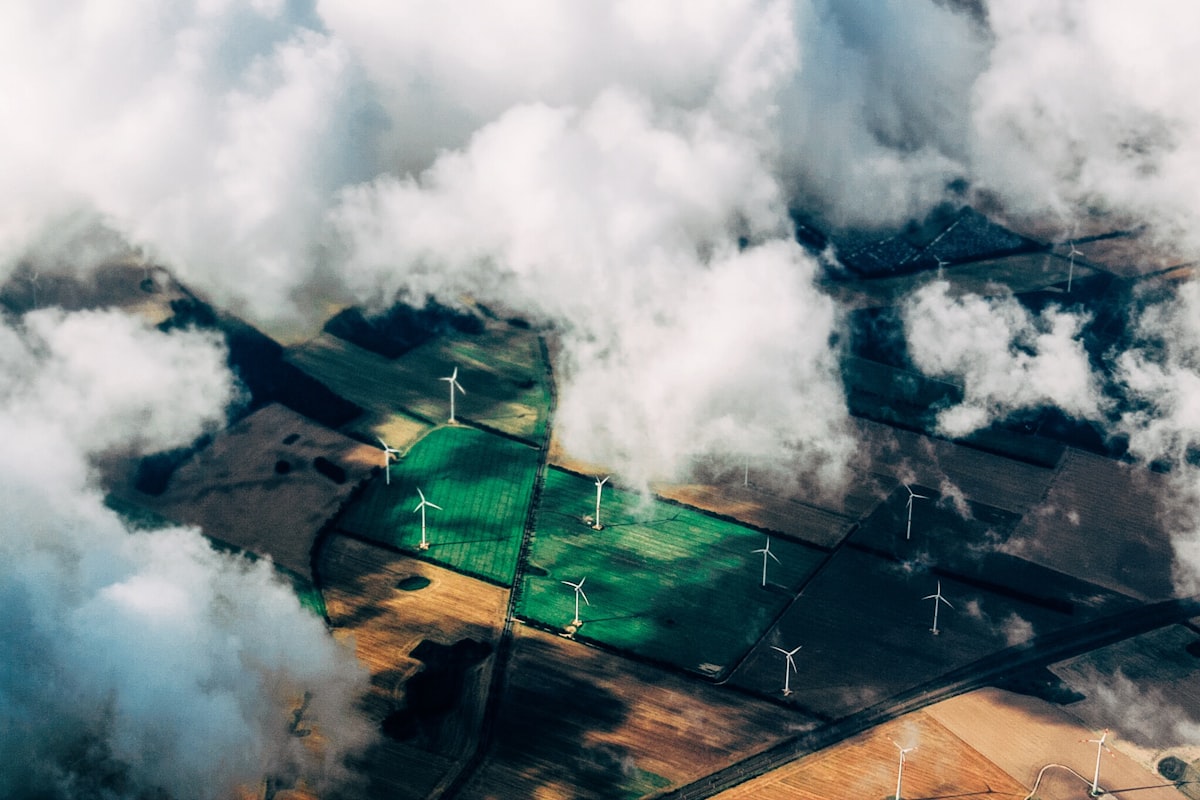
The transition to renewable energy is central to climate policy, but requires coordinated carbon pricing to accelerate investment at scale. Photo: Thomas Richter / Unsplash
"A fragmented carbon market is better than no carbon market, but it is not nearly sufficient to drive the investment in clean energy at the speed and scale that the climate challenge demands." - IEA World Energy Outlook, 2024
The EU Carbon Border Adjustment Mechanism
The European Union's Carbon Border Adjustment Mechanism, which began its transitional phase in 2023 and will be fully operational from 2026, represents an attempt to address the competitive distortion problem. By requiring importers of certain carbon-intensive goods to purchase carbon certificates equivalent to the price that would have been paid under the EU ETS, the CBAM aims to level the playing field between European producers who face a carbon price and foreign competitors who do not.
The mechanism has attracted both praise and criticism. Proponents argue that it creates incentives for trading partners to adopt their own carbon pricing rather than face border charges, potentially triggering a race to the top rather than a race to the bottom on climate ambition. Critics, particularly in developing economies, argue that it is a form of protectionism that disadvantages countries that lack the institutional and fiscal capacity to implement comparable carbon pricing.
Towards a More Coherent Architecture
A growing body of academic and policy work advocates for a minimum global carbon price floor, coordinated among major emitters, as a way of addressing fragmentation without requiring full harmonisation. The International Monetary Fund has modelled a floor of around 75 dollars per tonne for high-income countries by 2030, with lower floors for emerging and developing economies. Under this scenario, modelling suggests that roughly 23% of the emissions reductions needed to stay consistent with 2 degrees Celsius of warming could be achieved at a fraction of the cost of current policies.
Whether such coordination is politically achievable is a separate question. The history of international climate negotiations suggests that ambition and political will do not always move in the same direction. But as the physical costs of climate change become more apparent and the economics of clean energy continue to improve, the case for more coherent carbon pricing architecture grows stronger with each passing year.
Sources
World Bank, "State and Trends of Carbon Pricing 2024." worldbank.org, 2024.
International Energy Agency, "World Energy Outlook 2024." iea.org, 2024.
International Monetary Fund, "Fiscal Monitor: A Fair Shot." imf.org, October 2024.
European Commission, "Carbon Border Adjustment Mechanism: Questions and Answers." ec.europa.eu, 2023.
Stiglitz, J. and Stern, N., "Report of the High-Level Commission on Carbon Prices." carbonpricingleadership.org, 2017.

